

JMJ
✙
This is an edited repost from 2021.
THERE IS A TRADITION that St Joseph was much older that the Blessed Virgin when they were betrothed. One saint suggests that Jesus’ Foster Father was 91 when he married the Blessed Virgin! Other teachers, suggest mid-fifties. The reason for this tradition is generally understood to be the idea that an older Joseph would have been more likely to not be tempted by his beautiful young wife. Nowadays it’s becoming popular to show a young Joseph. This is new. Generally it’s not good to just throw out traditions of the church because we don’t like them or because they don’t feel good: this goes with (T)radition and also with (t)radition. So while the argument for Joseph not being 91 – or even 51 – may not make sense, it is a silly, modernist assumption to just toss it as if it were something the church just made up whole cloth. God would have wanted a proper father for the Infant Jesus. Does age matter as such? Yes, I think so. What is an appropriate age?
An older man is seen as better protecting the teaching of Mary’s perpetual virginity because he would not be tempted. This seems to be a bit of whitewash as anyone who has ever seen a “Trophy Wife” knows: lechery is not undone by age and, in fact, it is often a product of it. Then there is the logic of the issue: “Old men don’t walk to Egypt!” As Mother Angelica once said. I’m not stressed by that – in this culture whole tribes, led by their elders, moved great distances all the time. Also, this tradition, arising from the Protoevagelium of St James, posits Joseph as a very successful businessman the better able to care for the Handmaid of God.
Why do some want to imagine a younger Joseph? There is the walking. But there are also other reasons bordering on the lechery side. Archbishop Fulton Sheen has this to suggest on St Joseph’s age in his book, The World’s First Love:
To make Joseph appear pure only because his flesh had aged is like glorifying a mountain stream that has dried. The Church will not a ordain a man to the priesthood who has not his vital powers. She wants men who have something to tame, rather than those who are tame because they have no energy to be wild. It should be no different with God… Joseph was probably a young man, strong, virile, atheletic, handsome, chaste, and disciplined; the kind of man one sees sometimes shepherding sheep, or piloting a plane, or working at a carpenter’s bench. Instead of being a man incapable of love, he must have been on fire with love….Instead, then, of being dried fruit to be served on the table of the king, he was rather a blossom filled with promise and power. He was not in the evening of life, but in its morning, bubbling over with energy, strength, and controlled passion.
Why does Joseph need to be Mary’s age? Just for purity, or are there other issues? Traditional iconography often shows Joseph with grey hair. More modern images, especially in the West, depict him as about Mary’s age. Some writers have suggested that the Blessed Virgin was around 15 when she was betrothed to the man from Nazareth. Let’s call this younger man Joey. Do we need a “young man, strong, virile, atheletic, handsome“? Certainly, Hollywood does. Does the Church? This younger Joey is often imagined as some Manly Model for youth today who feel lost in a hyper-feminized culture. They give us rather disturbing images like the one below, where Joseph is clearly spending too much time in the gym to take care of his business or his future wife. This does not look like a young maiden, and this is not the way a poor carpenter looks:
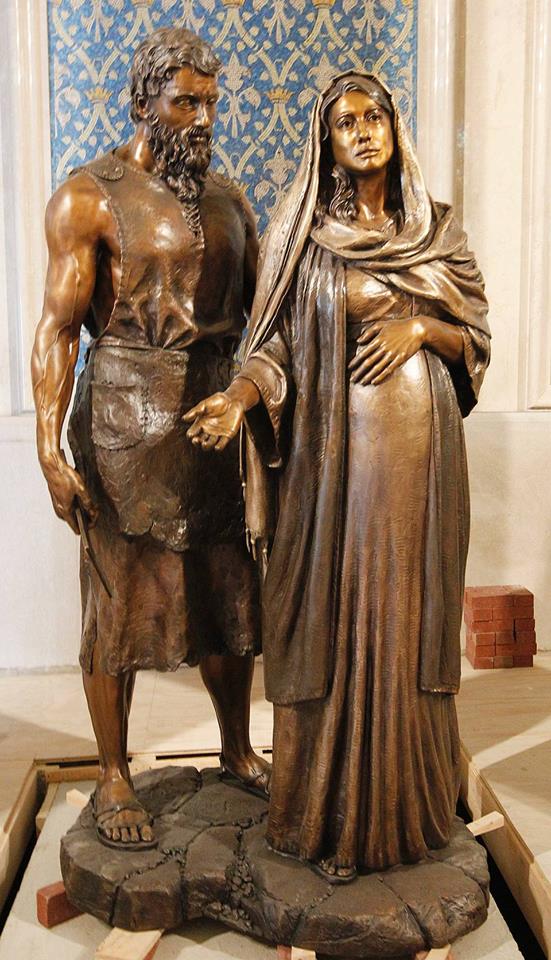
The idea of a fifteen-year-old Joey being able to navigate the emotional and political turmoil of the nativity seems unlikely. Fifteen-year-old Joey and a fifteen-year-old Mary in a cave in Bethlehem knowing what to do when labor started. Rather, they can be imagined in a full-scale panic. These two 15 year olds cannot be imagined as being much comfort for each other – even though that’s a good time to get married in this culture. AND a 15 year old Joey would not be on his own yet, the head of the family would still be Joseph’s father. The patriarch of this clan would have led them all to Bethlehem.
This idea that God would have wanted the father of appropriate age is fine, yet a teen is not it. In this culture marriages were often contracted for girls in their teenage years to an older man. There are benefits of age: wisdom, experience, strength. He would know how to move through the world on his own, he would be running his business and would not be afraid of tax collectors, would not be very stressed out by discovering that there was no room at the inn, and would not be afraid of having to walk to Egypt. This older (but not elderly) man, Joe, would be much better able to think on his feet with all these strange people and happenings that were about to come into his life. He would not be impulsive: he would plan. Discovering that Mary was pregnant Joe might actually think about it for a while, where the teenaged Joey might just get angry. Joey would not yet have his own house to bring Mary into, but Joe would.
There seems to be an answer in another older tradition that hangs on the Nativity. St James, called Jesus’ brother, is often understood to be the child of St Joseph by an earlier marriage. Joseph was widowed at a younger age and thus has children, but no wife. Traditional icons, following this tradition, show James leading the donkey:
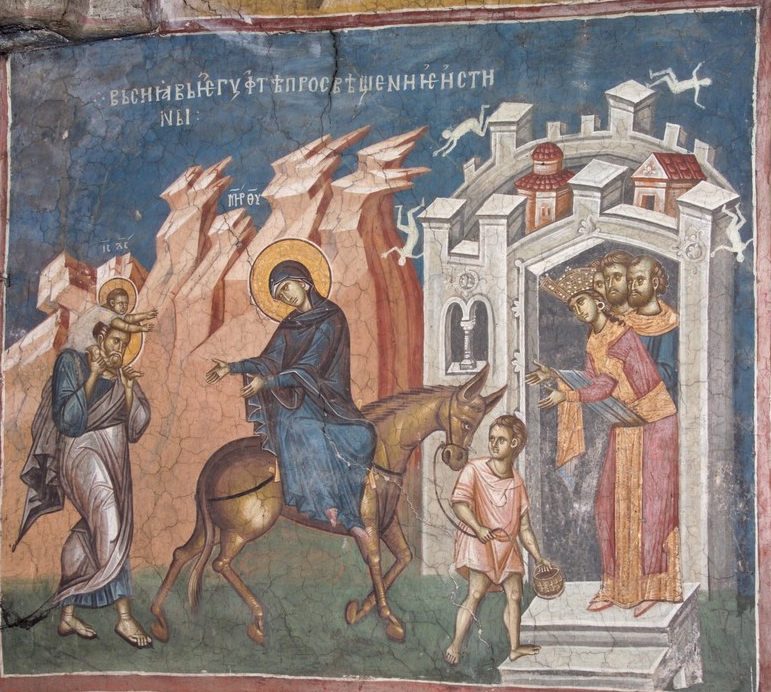
Theoretically, if a teenaged Joey had been married had 15, if his oldest son was now 10, and he was 25 – not 91! – he would know what to do. He would have been in at least one birth already, probably more. He would be a strong young man like Fulton Sheen imagines, old enough to care for the Blessed Virgin, to calm her down and to take care of her. He would be old enough to walk to Egypt and not so old that that would be impossible.
This idea of a 20-something or maybe 30-something Joe engaged to a teenaged Mary makes sense. He would be young enough to still need to train his impulses, yet old enough to have done some work on that already. His virtue would still be a struggle for him but his experience and piety would be firmly rooted. This seems to resolve both sides of the age issue while keeping the tradition intact.
The other thing that’s curious about Joey vrs Joe is that Joseph is entirely gone from the story by the time Jesus is a man. It is generally assumed in the Church’s tradition that Joseph died before Jesus began his Teaching Ministry. If Joe was 25 or 35 when Jesus was born he would have been in his 50s or 60s before the Teaching Ministry begin. It’s possible that he would have died by then: a poor man and a laborer, his life would have been hard. I can imagine such a man dying in his 60s and yet being a strong, shining example of a father and a man all though Jesus’ life to adulthood. Yes, the young Joey might also have died young, but imagining Joe becoming an elder and dying at an old age (for the time) makes much more sense.
There is no doctrinal requirement one way or the other on the age of St Joseph – this is all (t)radition. But here is a way where this tradition can fit with some logic, where Joe can be a man without needing a walker to get to Egypt, and where he can be a young, virile man, without needing to be a kid. Joey and Joseph can give way to Joe.
 Orthoparadoxy
You must be logged in to post a comment.