
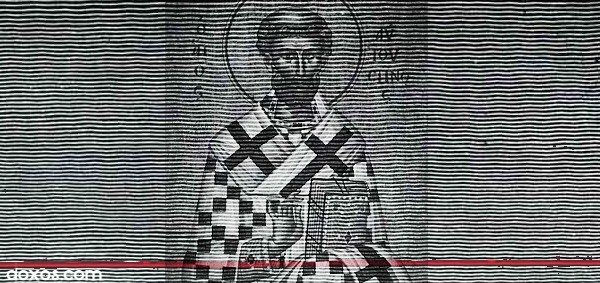
IC XC
✙
NI KA
A year ago, your host was the presenter to our chapter of Lay Dominicans. (This is a repost from that time.) We are currently reading St Augustine’s Confessions and my topic was Book 12 where the saint (seemingly) continues in an off-book digression on philosophy. There was a post in August where I ruminated for a while on what had happened in Book 11. And I brought up Chronostasis in the chapter meeting at that time. But then we got to this book, where he talks about Creation and How God Did It and I thought, “Did I miss a point somewhere?”
So here’s the fleshed out version of the notes I did.
1 Augustine: Doctor of the Church
Augustine enjoys a prominent place in the “hierarchy” of Western Saints.
One of four “Latin Doctors” of the Church – along with Sts Gregory the Great, Jerome, and Ambrose.
Also four Greek Doctors – Sts Basil the Great, John Chrysostom, Gregory the Theologian, and Athanasius.
However…
2 In the East, not so much.
Augustine is not so popular in the Christian East. He was not celebrated at all on the liturgical calendar until recently (even so, only by the Greeks in America).
He didn’t speak Greek (he admits this and says he actually disliked it).
Seems entirely unfamiliar with any of the Eastern Saints or Fathers – even those living at the time. Although he allows that if someone were to translate them in to Latin he might be interested in reading them.
Doesn’t tie in well with Eastern concepts of Ecclesiology or Theology.
And then there’s this problem with one of his followers…
3

4 Luther brings Augustine to the Reformatting West
Basically the Only Church Father the Protestants like.
His views become Protestant Doctrine – we’ll see this in Chapter 11, actually – especially if they are taken out of context.
If you don’t let the consensus of the Church Fathers fool you, Augustine can sound very Protestant.
5
Which brings me to the title of this Slide Deck
6
What the Heck is This?
Augustine’s Digression on Time and Creation
7 Source of the Title
A fun commentary on a copy of the book that was previously owned by a very pious Protestant which I borrowed from the Library. His handwriting is all through the first several chapters and he’s having none of Augustine’s theological musings.

That’s certainly a man’s handwriting! I think he was reading Augustine for the first time in a critical way and realizing that Saint was very Catholic.
8 Book 12 – Line of Argument
What seems to be going on?
There is an extensive argument about how creation was made – from something or from nothing? Augustine says from nothing – ex nihilo.
Then he attempts to prove this by offering a very mystical (? Spiritual? Platonic?) reading of the opening verse of Genesis. (We’ll come back to this in a moment as it is the meat here…)
Then he posits fights with imaginary folks who say you can’t prove things in that way. And he tries very hard to fight off the straw men he has created.
He gives the most space to the folks who say, “Even if you are right, what you are saying is not what Moses was intending to say when he wrote Genesis so your attempt to draw it out of those verses is silly. Just make your claims and leave Moses out of it.”
9 Postmodernism?
Augustine says in ¶42 that any truth human readers can find in the passage was Truth intended by Moses because he intended to convey all the truth God was giving him. So if Augustine’s reading of scripture is correct, then, in fact, that is what Moses intended.
This can be very frustrating to modern readers who want to see either literal truth or codswallop in the words. This sounds like circular reasoning, but it’s not.
Augustine is very patristic. If we find truth in mystical contemplation of the text, then that truth was intended by the writers and by the Holy Spirit who is the Author of the whole kit and caboodle. God is all truth. If what Augustine says is part of the Truth then it’s something God put into the text: even if Moses did not know he was saying it.
10 The Meat of the Argument
Augustine reads these two verses from Genesis 1:
א In the beginning God created the heaven and the earth.
ב And the earth was without form, and void; and darkness was upon the face of the deep.
He says there is an implied gap there. Heaven was created and yet the earth was “void”.
This is – according to St Augustine – God creating formless matter, to use a philosophical language. To this matter, God added form. And thus we get everything that is.
In our created world there is no matter without form and no form without matter.
Every individual thing (a substance) is an intersection of form and matter. For human beings, the form is the soul.
11 SO THEN, What the Heck is this?
12 It’s Either
Augustine’s chapters on Space and Time, form and matter, are either,
- an excursus “a detailed discussion of a particular point in a book, usually in an appendix.”
- A digression “a temporary departure from the main subject in speech or writing, ‘let’s return to the main topic after that brief digression’”
- Or an integral part of his argument. That is, the argument of the whole book.
13 So then…
That last is my assertion. These two chapters (or, Books, to use Gus’ terminology) are not external to the argument he is making but valuable parts of it. What then, is the argument he is making? What is the point of the Whole Book?
Once we know they argument we can determine what Book 12 (and, really, Book 11 as well) are doing here.
14 Two Possible Outlines – Option One
You already know that this is not my belief, but here is the usual reading of The Confessions. This is a psycho-spiritual biography. To read it this way, you do not need (so it is asserted) books 11 and 12. You can skip those (I actually heard this in a sermon this morning, 28 Aug 24.)
- Introduction
- Opening Prayers
- Childhood
- Opening Pears
- Everything Goes Horribly Wrong
- Mother’s Prayers
- God Saves
- What Is Time
- What Is Creation
- Closing Prayers
15 A Spiritual Biography, Yes, but…
But also. An apology (that is, a defense) of his whole life – to those who know his past. And a confession for those who do not know it.
So then we arrive at an interesting question towards the end of Book 10 ¶65…
O Truth, is there any road where you have not walked with me, teaching me what to avoid and what to aim at, whenever I referred to you the paltry insights I had managed to attain and sought your guidance? …
He notes that he has walked through his entire life. And none of the things he recounted was God actually acting as it seems, on the surface. He can’t see God in his memories.
16 Abiding Light
God, he says, was the light that was guiding him all along. Even when he was in darkness. God has walked with him on every road – even the adultery, even the heretical sects, even in the pear tree. Therefore, these two books about space and time seem, to me, to be making an entirely other point.
17 These Chapters are Not A Digression
18 Two Possible Outlines – Option Two
- Introduction
- Opening Question
- Biography and Long Journey
- Pears Etc
- Conversion
- What does that mean to me
- How did it happen
- In Time
- In Space
- Closing
19 Time and Space
Augustine is showing us (and maybe himself) how it is that God brought Grace to be. He is answering the questions he posed in the very 1st Paragraph of Book 1. “Must we know you before we can call upon you?… How can people call upon someone in whom they do not yet believe? And how can they believe without a preacher?”
How is it that he who did not yet believe, come to Faith in God?

20 How does a sinner find God?
It seems that Augustine’s Entire Argument was that no matter how far he moved away, God was still actively moving him back.
The present speaker has a vested interest in this argument.

21 But if that voice was behind me calling me back
In Book 12, ¶11-14, the argument is:
¶11A – God is all being without change (beyond time as in book 11)
¶11B – To walk in God’s light is to be. To walk away from God’s light is to sin..
¶12 – There is a “place” (Heaven’s Heaven) where the unity between God’s will and God’s creation is perfectly realized.
¶13 – Even a Soul on a long journey away from Heaven’s Heaven can still hear the cry of the soul “Where is your God?”
¶14 – Even someone who has God as far away as possible has not become “formless” and even then, God – who brought form out of formlessness – can save us.
22 God has Only one will
God’s one eternal act of will never changes – that all men come to a saving knowledge of Christ.
What unfolds in Creation is that one act of divine and eternal will happening in a way we can see unfolding. We are all being moved to a saving knowledge of Christ.
Please note: this is not universalism. Augustine says that to step away from that one act of will is to step towards non-being and formlessness. This is a possible choice for any man to make.
But even that formlessness is something God created so it is possible for even those furthest from God to be called back to that one act of Divine Will.
23 Suggestion
Augustine’s argument with the Straw Men he invents is against those who would say either
– “No sinner like you should stand at the Altar.” or,
– “If you made such a break with your past life you’re not even the same person.”
Augustine’s argument is that when he was drifting in sin, he was, moving to formlessness, away from personhood, yes. But it was God WHO called him back – by virtue of the inner voice that calls us all to be fully persons. Even when we don’t realize it, that call is calling us to God.
So it seems that St Augustine, who is writing a Spiritual Autobiography, wants to make the point that to tell anyone’s story is not an individual act: everyone’s story involves all of Creation, all of Time, and all of Eternity because every human being’s story involves, exactly, God.
The Meme is true (making fun of Atheists): “God made a bazillion stars, whole galaxies we’ll never see, an entire universe of things that could possibly happen in Billions and Billions of years, just to have a personal relationship with… me.”
“Yes. Exactly,” says Augustine. Yes. Exactly. And with you, dear reader. That is how much you are loved, no matter where you are on this journey away or toward.
One cannot tell one’s own story apart from the Universe and the Creator. God is intimately and infinitely involved in everyone’s story. The act of drawing you to him began in the one act of will which we experience unfolding in time, but for God, is from all eternity to all eternity, the one act of Love.
 Orthoparadoxy
You must be logged in to post a comment.