IC XC
✙
NI KA
O Emmanuel, our king and our lawgiver,
O Antiphon for 23 December
the hope of the nations and their Saviour:
Come and save us, O Lord our God.
Jesus goes up to the Temple for the Feast of the Dedication (in the Gospel of John 10:22ff). This “Feast of the Dedication” is Hanukkah, it’s winter, according to John, and Jesus is walking in Solomon’s Portico, in the area behind what is now known as the Hulda Gates. John does not usually paint a picture of Jesus doing “something Jewish” without it meaning something. And as today’s date (15 December) happens to fall on the day after the last night of Hanukkah (last night, 8 candles were lit), it seems a good day to ask why did John paint this particular picture of Jesus doing something Jewish?
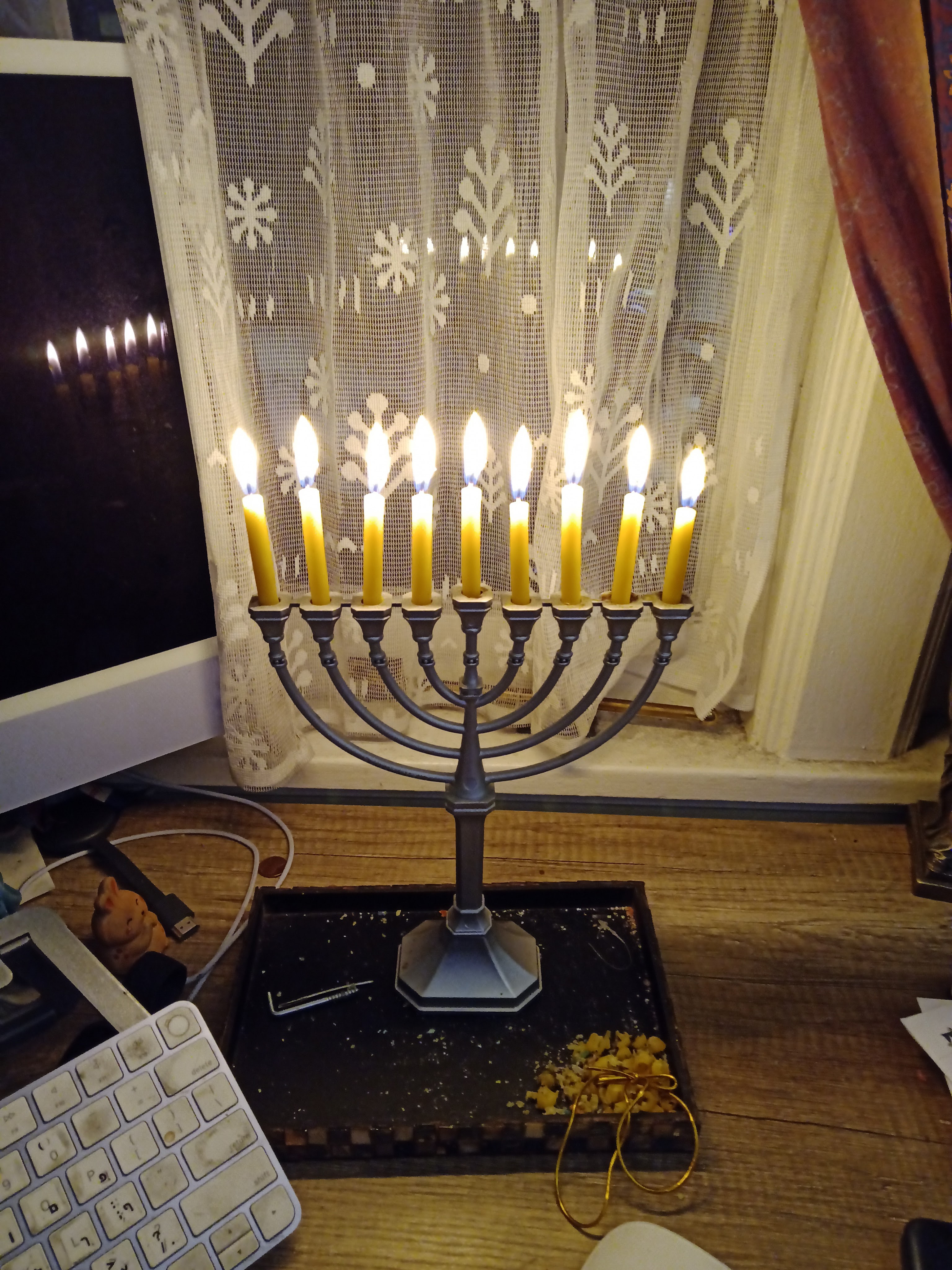
As I wrote a couple of days ago, the idea of the “miracle of the oil” arose after the “miracle of the military victory” was downplayed. There are other explanations for this change related to internal politics or other issues. But, given Christian persecution of the Jews, “let’s downplay this military triumphalism” also seems a likely candidate. That said, there is no mention of the miracle in either the Books of the Maccabees, or in the Gospel of John. The former mentions an eight-day festival celebrating the Victory and the latter says Jesus was observing it. We’ll go from there. To be clear of something before we go on: neither John, nor Jesus, (nor this writer) is saying that suddenly there’s a “Christian Meaning” to Hanukkah. Only that John was using the existing Jewish Meaning (a military Victory over Gentiles) which would have been known to his largely Jewish audience to paint a theological picture.
In the wider context of this portion of John, Chapters 9-10, Jesus has come to Jerusalem after having healed the Man Born Blind (the body of Chapter 9). He tells the Pharisees “I am the Good Shepherd” (10:14) and makes his claim that “I have other sheep that are not of this sheep pen. I must bring them also. They too will listen to my voice, and there shall be one flock and one shepherd.” Further, he makes says that he has this command from God to bring unity, “This command I received from my Father” (10:18). Now, at that time, was the Feast of the Dedication, and Jesus was walking in Solomon’s Portico…(10:22) and this portico was a double row of columns on the east side of the Court of the Gentiles. He’s in the temple area, but only in the area open to everyone who has come to worship, not restricted only to Jews. And I think that’s the point.
John makes several links between Jesus’ person and the Kingdom (the Church Fathers would go so far as to use the term “autobasileia“, but Jesus also makes the connection between the Temple and his Body. Which he then hands over to his Disciples in the Eucharist. So a feast celebrating the Dedication of the Temple and its rescue from Gentiles becomes, in Jesus actions, the proclamation that Gentiles would be included in the New Temple that is Jesus’ Body.
And Jesus is not restricting his claim only to unifying all the factions of mankind in himself. For then he says – still in the context of the Hanukkah festival – “I and the Father are one” (10:30). Jesus is celebrating the dedication of the New Temple of His Body in which all humanity will be united with himself… and with the Father. This is the theological claim of Theosis or Divinization. What God is by nature, we can become by grace: united with the Father in the Son who tears down the wall of division between “Jew and gentile, slave and free, man and woman” and brings us together in Love.
This is the meaning of “Emmanuel” in today’s verse, “our king and our lawgiver, the hope of the nations and their Saviour.” The our there, is “us Jews” and the their there is “them goys”. Jesus is the unifying force, the one thing needful.
God is with us.
In English (and in Hebrew, as well as Greek and Slavonic, but maybe not Latin? I don’t know) “with us” can mean both “here, in the room with us” and also “on our side”. This is why in the Great Compline of Nativity the Orthodox Church sings (in Slavic languages or Greek or English)
“Refrain: God is with us!
Understand, all you nations,
and submit yourselves
for God is with us!With verses like:
God is with us!
If you strengthen yourselves again,
again you will be defeated,
for God is with us.
Form a plan,
but the Lord will thwart it,
for God is with us.
Whatever word you speak
will not stand even among yourselves,
for God is with us.
We will not fear what you fear
nor shall we be dismayed,
for God is with us.
And so it is true that there is “God’s side” and the losing side. But it is ironic – and sad beyond comprehension – that we have consistently played that into meaning “us against them”. When Rabbi Sha’ul of Tarsis (or, to use his Roman name, Paul) so clearly says, “For we wrestle not against flesh and blood, but against principalities, against powers, against the rulers of the darkness of this world, against spiritual wickedness in high places” (Ephesians 6:12). Any time we see our enemies as being anything other than human beings, created in God’s image, we’re siding with the Demons, the rulers of the darkness of this world. Emmanuel is a call to us all to come into the light, to dedicate ourselves to the struggle to liberate the world from demonic darkness.
This is Hannukah.
 Orthoparadoxy
You must be logged in to post a comment.