IC XC
✙
NI KA
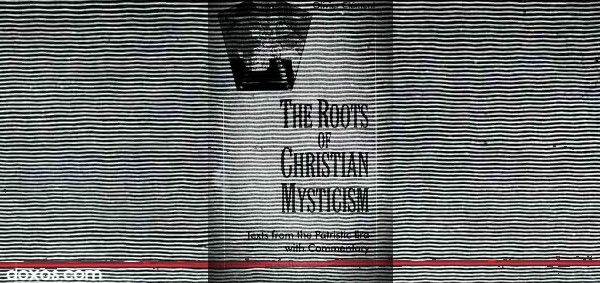
THE COVER IMAGE is one of my favourite books of all times, The Roots of Christian Mysticism by Fr Olivier Clement. I have owned three copies of it, I think. Maybe four. Until recently, I also had my original one: the cover was broken and almost every page was marked up. The writer, an Orthodox priest, offers a running commentary on patristic teaching which he sums up in a multiple quotes on each page. There’s a chapter of his work on the Myriobiblos website here. It’s very well done. The teacher of the class in which I was first taught this material imagined Fr Clement in his office with index cards of quotes everywhere, each with citations, and another collection of quotes without citations floating around in his head. There was only one problem. I loved the material so very much that I went and looked up the material in context. Specifically, I was looking up St Ignatius of Antioch and St Irenaeus of Lyon. I was able – because of Fr Clement’s citations – to find the material. But, in context, sometimes the meaning was very different from what the book seemed to indicate.
Just by means of one example, “The glory of God is a living man” is a known phrase from St Irenaeus (today is his feast). That line is quoted in this section here. It sounded rather glorious surrounded by Fr Clement’s commentary but – it will come as no surprise to my reader – the definition of “living” in the source text is dying to self, living in Christ, being an orthodox, Catholic Christian, submitting to the full teachings of the Church. There is, of course, no other possible definition of “living”. But to the eyes of a Protestant (at that time I was Episcopalian) there are many possible ways to imagine it – especially during “Pride” week. Fr Clement writes a book that many a liberal Protestant could love. “Thus holiness is life in its fullness. And there is holiness in each human being who participates vigorously in life. There is holiness not only in the great ascetic but in the creator of beauty, in the seeker after truth who heeds the mystery of creation, both living and inanimate, in the deep love of a man and a woman, in the mother who knows how to console her child and how to bring it to spiritual birth… God envelops in his fullness the person whom he deifies. And that person by the clinging power of love is united wholly to the divine energy. From nοw οn there is only one energy of God and the saints: God is ‘all in all’, ‘everything in everything’.” But the Church Fathers do not at all mean anything prideful. For nearly every cited quote in Clement, one needed only read a few lines before and after to realize that the composer of the book had highlighted one meaning – very real – in the quote but the frame had made it seem like that was the only meaning in the quote.
What the author was doing was reading his own meaning into the work of the Fathers and pulling content out of context to justify his reading. It was not very edifying to realize this. I pointed this out in class and the teacher’s response was “Yes, but there is this other voice in the fathers which we can hear…” and, for a while, this helped. This “liberal” meaning is one of the meanings in the fathers.
But then, no.
A common question is could God have done things in another way. And many a Catholic, Orthodox, and Protestant has been willing to walk that path, exploring the possibilities.
But, what God are you talking about at that point?
Salvation – the action of the atonement – is not something God has done: it reveals who God is in relationship to us. The revelation of who God is is in the Incarnation, Crucifixion, Death, Resurrection, Ascension, and Glorious Second Coming of Messiah. There is no other God. If we imagine a god who offers another path of salvation that is literally another god – not the God we know. It is possible to read another god into the Fathers. But they are not talking about that other god – they only know the God revealed to us in Christ. That revolution is so final, so climatic, that it gives us everything in the world backward and forward in time and eternity: everything is the shockwave of the incarnation of God and the apocalypse of the Cross.
Everything else is the unpacking of that and nothing more. Any attempt to read the Fathers outside of that, any attempt to read the scriptures or the Holy Mysteries apart from that manifestation, that theophany is to destroy the context needed to understand anything at all.
 Orthoparadoxy
You must be logged in to post a comment.